

Reaching Local Clients: How Local SEO for Law Firms Commands Regional Authority
For decades, the growth of a law firm in Kenya—whether nestled in the bustling commercial streets of Nakuru or the expanding agricultural hubs of Eldoret and Thika—relied on a singular, invisible engine: the informal referral. An advocate’s reputation was built over tea in private clubs or through long-standing family ties. While this “word-of-mouth” remains the gold standard of trust, a quiet revolution has fundamentally altered the path a client takes before they ever step into your chambers. Today, the traditional referral is no longer the final destination; it has become the starting point of a digital investigation where Local SEO for law firms determines your visibility.
In the modern Kenyan legal landscape, even after a personal recommendation, the prospective client’s next move is reflexive: they reach for their smartphone. They are looking for a digital signal that confirms your professional standing. When a client in a growing town searches for “Conveyancing advocates in Nanyuki” or “Lawyers near me,” they aren’t just looking for a phone number; they are looking for the most Institutionalized presence in their vicinity. If your firm is not appearing in these regional searches, you are effectively invisible to the next generation of clients.
For the new or growing law firm, the challenge is clear: if you are not visible in that moment of local intent, you do not exist to a significant portion of the market. This is the essence of Local SEO for Law Firms. It is not about “marketing hype”; it is about establishing the Professional Standards that ensure your firm is the obvious choice in your specific geography. This article explores how to move your firm from an “Informal” state of accidental discovery to an “Institutional” state of regional dominance through disciplined digital standards.
1. The Digital Plaque: Google Business Profile (GBP) as a Foundation
In the physical world, your firm’s plaque at the gate of your office signifies your presence and legitimacy. In the digital world, your Google Business Profile (GBP) serves this exact function. For upcountry and regional firms, the GBP is the single most effective tool for capturing local demand at the point of need. It is the bridge between a search query and a physical consultation.
According to Google’s insights on local search behavior, “near me” searches have grown exponentially. For a Kenyan advocate, a fully optimized profile ensures your firm appears in the “Local Map Pack.” However, the Hamid Focus philosophy of “Order over Hype” dictates that this profile must be more than just a listing; it must be a repository of factual integrity. Under the Advocates (Marketing and Advertising) Rules, 2014, advocates must ensure their information is “accurate and not misleading.” This means your GBP must strictly display factual details without using superlative language. By maintaining a clean, verified profile, you signal to both Google and the client that your firm operates with a high degree of order.
2. Technical Integrity: Website SEO and Local SEO for Law Firms
Transitioning from an “Informal” to an “Institutional” state requires moving beyond a simple website. Your digital presence must be architected to speak the language of search engines. This is where Technical SEO and Schema Markup become your firm’s invisible competitive advantage. While generic SEO focuses on broad terms, Local SEO for law firms focuses on “Geographic Keywords” that drive actual foot traffic.
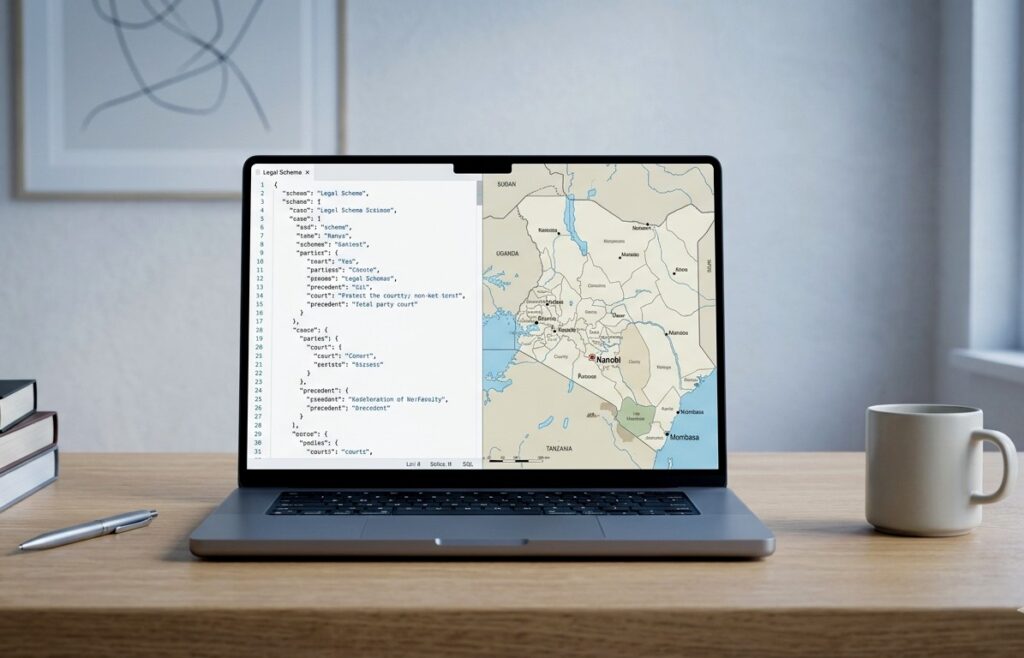
For a firm in a regional hub, trying to rank for “Lawyers in Kenya” is a “Red Ocean” strategy—there is too much noise. Instead, focusing on “Advocates in Nakuru” or “Succession lawyers in Trans-Nzoia” represents a Blue Ocean opportunity. This technical integrity is reinforced by Local Business Schema. This snippet of structured data tells search engines exactly where your jurisdiction lies. As noted by Search Engine Journal, structured data is the most direct way to improve how your business is represented in search results, moving you away from “Hype” and toward “Ordered Data.”
3. Content as Regional Authority: Solving Local Anxieties
The most common mistake growing firms make is producing generic content. At Hamid Focus, we advocate for Educational Positioning. Your content should not “sell” your services; it should “solve” regional anxieties. Consider a firm in the North Rift. An “Order-led” approach would be a guide titled: “Navigating Land Subdivision in Uasin Gishu: A Guide to Local Procedures.”
By creating content that addresses local land laws or regional commercial trends, you establish Verbal Authority. This type of locally-focused content serves a dual purpose: it educates the client and it signals to Google that your website is the most relevant authority for that specific region. This is how a new firm outranks established giants—by being more relevant to the local context than the national one.
4. Social Media Integrity and Compliant Search Ads
Social media for law firms should be viewed as a tool for Social Integrity. For a regional firm, social media is a way to stay “top-of-mind” through Ordered Presence. Your strategy should focus on Regulatory Updates and Community Leadership rather than constant “sales” posts. This approach complies with the LSK’s dignity standards. Read our previous article on social media compliance.
Furthermore, Google Search Ads (PPC) represent a “new opportunity” for visibility. Unlike billboards, a search ad is “directed information.” It only appears when someone is actively searching for a specific service. When executed with Hamid Focus standards, these ads provide factual data: the firm’s name, contact information, and specific area of practice. It is a strategic, compliant shortcut to regional reach that levels the playing field.
Conclusion: The Scalable Foundation

Reaching local clients in Kenya’s evolving legal market is no longer a matter of chance; it is a matter of Strategy and Digital Standards. By aligning your Google Business Profile and website architecture with a philosophy of “Order over Hype,” you create a firm that does not need to shout to be heard. In the Blue Ocean of regional practice, the firm that establishes the highest digital standards through Local SEO for law firms is the firm that will ultimately command the market.
Frequently Asked Questions (FAQ)
How much does it cost to set up a Google Business Profile for a law firm?
While the Google Business Profile platform itself is free, the professional setup and optimization to ensure LSK compliance and maximum local visibility typically costs between KES 10,000 and KES 25,000 as a one-time professional fee. This ensures your “Digital Plaque” is verified and correctly categorized.
What is the typical cost of Local SEO for law firms in Kenya?
For growing firms, a retained strategy for Local SEO for law firms generally ranges from KES 25,000 to KES 60,000 per month. This investment covers ongoing content creation, schema maintenance, and regional keyword optimization to ensure you stay ahead of competitors in your town.
Can Local SEO help me compete with larger firms in Nairobi?
Absolutely. Local SEO for law firms is designed to prioritize regional relevance. By focusing on your specific town (e.g., “Advocates in Thika”), you can outrank national firms who lack a localized digital presence, capturing the client at the moment of regional need.
Are Google Ads for law firms legal under LSK rules?
Yes, provided the ads are informative and factual. Under the 2014 Marketing Rules, digital ads that provide your firm’s name, location, and services without using persuasive or “touting” language are permitted as a form of professional information dissemination.
This article is part of our series on Law Firm Strategy. To learn more about our 4-Step Process for migrating your firm to an institutional state, contact Hamid Focus today.